⚠️ Affiliate Disclosure: This post may contain affiliate links. If you purchase through these links, we may earn a small commission at no extra cost to you. We only recommend products we genuinely believe in.

What does a lifetime of marathon running actually do to your body? A new study in Scientific Reports tackled that question with striking results: 340 dedicated multi-marathoners spread across 24 countries were found to carry VO2 max scores well above population norms in every age group studied — and in several cohorts, their aerobic capacity landed above the 95th percentile for their sex. The implications extend far beyond competitive running. VO2 max is one of medicine’s most consistent predictors of all-cause mortality, and these findings suggest that sustained endurance training may compress the aging curve for cardiovascular fitness in ways that matter enormously to long-term health.
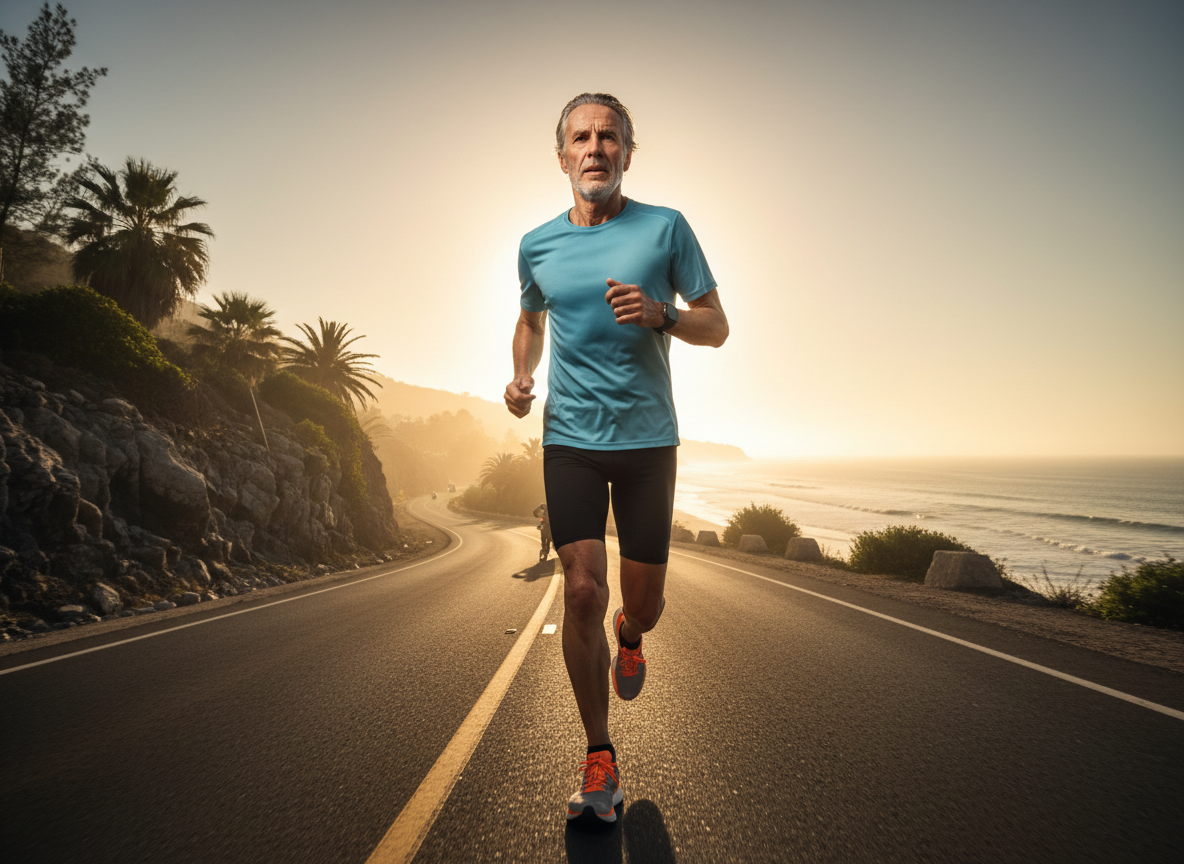
Running Decade After Decade Preserves Aerobic Capacity Far Beyond Population Norms
The cohort — averaging 52.2 years of age and 121 marathon completions per participant — was assessed using VO2 max estimates from popular wearable devices including Garmin, Polar, and COROS. Researchers compared these scores against the Fitness Registry and Importance of Exercise (FRIEND) database, the gold standard for age- and sex-adjusted aerobic fitness norms. The gap was substantial: multi-marathoners consistently outperformed their peers, with older participants showing the most pronounced divergence. Women in the group, particularly those over 60, demonstrated a relative advantage over age-matched female population norms that actually exceeded the relative advantage seen in men — a nuance that may have implications for how endurance training guidelines are tailored across demographics.
What the Research Says
The study, “VO2max ageing and all cause mortality in a global cohort of multi marathoners,” was published on May 12, 2026 in Scientific Reports (doi: 10.1038/s41598-026-52475-x) by researchers Leo Lundy, Richard B. Reilly, and Neil Fleming at the University of Dublin’s Human Performance Laboratory. The team applied established meta-analytic models — which link a 3.7% reduction in all-cause mortality risk to each additional 1 mL/kg/min of VO2 max — to project the survival advantage of the cohort’s elevated aerobic fitness. While the researchers note that cross-sectional design cannot prove causation, and that wearable-derived VO2 max carries roughly ±10% measurement error, the consistency of the advantage across age groups and 24 nationalities strengthens the case that sustained endurance training produces lasting changes to cardiovascular aging trajectories.
What This Means for Your Training
You do not need a race bib to benefit from these findings. The biological mechanism behind the results — sustained aerobic training preserving cardiac output, peripheral oxygen extraction, and mitochondrial density — operates whether you run a local 5K loop or an organized marathon. What matters is the accumulation of consistent aerobic effort over years and decades. Research has shown that beginning vigorous aerobic exercise even in middle age can substantially raise VO2 max within months, and those gains prove durable when the training habit holds. The study also reinforces a growing expert consensus: if longevity is a primary goal, building and defending your VO2 max ranks among the most valuable interventions available to otherwise healthy adults. A wearable that tracks your aerobic fitness trends turns that principle from abstract to actionable — watching your VO2 max trend line across months of training tells you whether your program is working before any other metric does.
Frequently Asked Questions
Q: Do I need to run marathons to preserve VO2 max as I age?
A: No. The multi-marathon participants represent the extreme end of endurance commitment, but the cardiovascular adaptation behind their results is not exclusive to race-length training. Consistent aerobic exercise — three to five sessions weekly maintained across years — produces measurable VO2 max preservation in recreational athletes. Studies show people in their 60s who maintain regular aerobic habits often test comparably to sedentary individuals a decade younger on VO2 max benchmarks. The variable that matters most is lifetime accumulation, not any single event or distance.
Q: How accurate are smartwatch VO2 max estimates for tracking my fitness over time?
A: Wearable VO2 max estimates carry an acknowledged measurement error of approximately ±10% versus laboratory gold-standard testing. For absolute benchmarking, a formal VO2 max test at a sports performance lab remains the standard. That said, wrist-based estimates are genuinely valuable for tracking trends: a consistent upward trajectory across 60 to 90 days of training reflects real physiological adaptation, even when the absolute number carries measurement uncertainty. Garmin and other major platforms calibrate estimates using heart rate reserve and pace data from outdoor runs, and accuracy improves with consistent device use and updated user profiles.
Q: What training approach most effectively raises VO2 max?
A: Research consistently points to high-intensity interval training (HIIT) as the most efficient method for increasing VO2 max per unit of training time. Sessions involving repeated 3–8 minute efforts at 90–100% of VO2 max pace — classic examples include 4×4 minute intervals at near-maximum effort — trigger the strongest aerobic adaptations per session. These should be layered onto a base of consistent moderate-intensity Zone 2 aerobic volume, which builds the mitochondrial infrastructure that sustains high-intensity adaptation over time. The ACSM’s updated 2026 guidelines also recommend complementing endurance work with strength training two to three times weekly for comprehensive longevity outcomes.
Further Reading
- Full study: VO2max ageing and all cause mortality in a global cohort of multi marathoners — Scientific Reports, 2026
- ACSM 2026 Resistance Training Guidelines — First major update in 17 years, including aerobic fitness context
- Examine.com Fitness Guide — Evidence-based overview of aerobic exercise, VO2 max, and health outcomes
📊 Track Your VO2 Max — Start Today
The Garmin Vivoactive 5 estimates your VO2 max on every outdoor run and shows you whether your training is actually moving the needle on the metric that matters most for longevity. Read our full hands-on review.
Leave a Reply