⚠️ Affiliate Disclosure: This post contains affiliate links. If you purchase through these links, we may earn a small commission at no extra cost to you. We only recommend products we genuinely believe in.
For many adults over 65, the prospect of fitting exercise into an already-full day can feel daunting — especially when public health guidelines call for 150 minutes of moderate activity per week. A new randomized trial from Penn State College of Medicine suggests that the threshold for meaningful physical improvement may be far lower than most people assume. Researchers found that a structured daily workout totaling just four minutes produced significant gains in leg strength, standing balance, and sit-to-stand speed in sedentary older adults with walking difficulty — gains achieved in just 12 weeks.
A Four-Minute Daily Routine Produced Measurable Gains in Strength and Balance — Without a Gym or Trainer
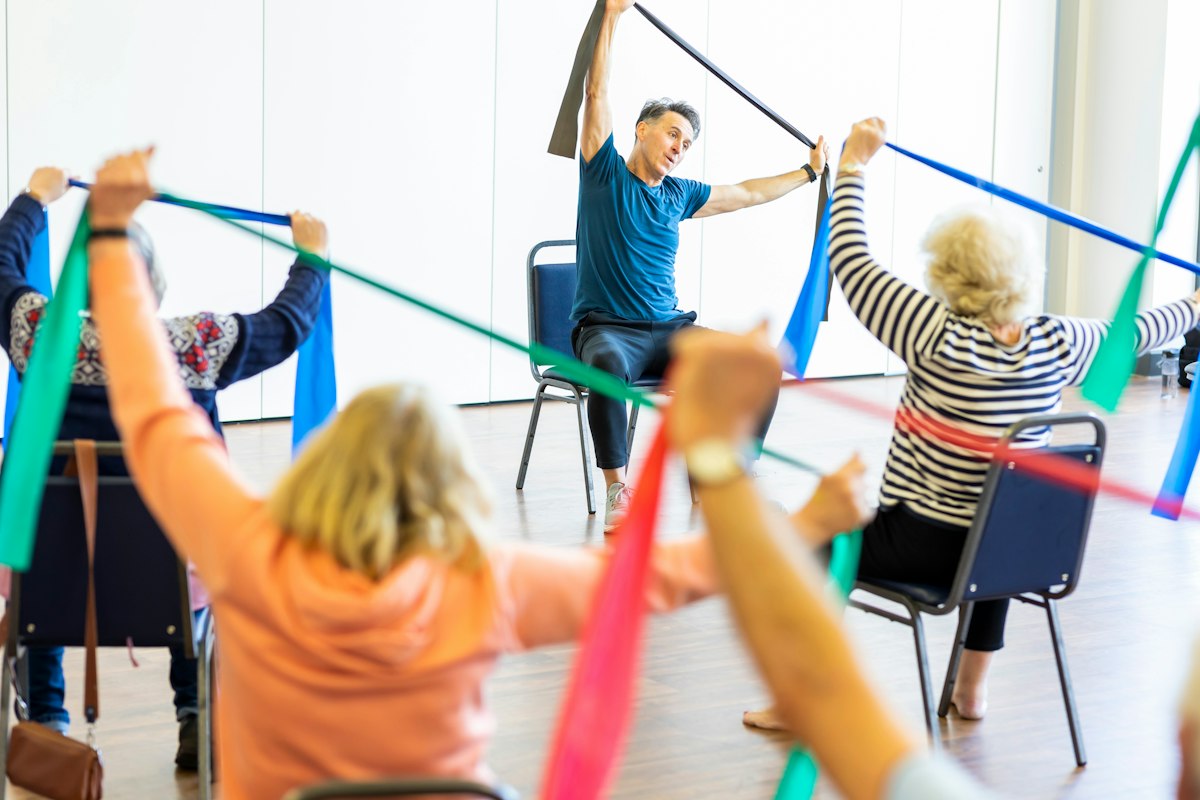
The trial enrolled 97 adults with an average age of 74, all of whom reported difficulty walking a quarter mile unaided and exercised only about 18 minutes per week on average at the start. Participants assigned to the FAST-2 program performed four exercises — push-ups, chair stands, two-arm resistance band rows, and stair stepping — for 30 seconds each, with 30-second rest intervals in between. The entire session took roughly four minutes. Over 12 weeks, participants completed the routine on 81 percent of assigned days. At the end of the trial, those in the exercise group could perform 4.22 more chair stands in 30 seconds, hold a single-leg balance for 3.57 seconds longer, and complete the five-times sit-to-stand test 2.28 seconds faster than controls — all statistically significant differences.
What the Research Says
The study, led by Christopher Sciamanna at Penn State College of Medicine, was published in PLOS ONE in 2026. It builds on an earlier pilot called FAST-1, which used 30 seconds of push-ups and squats with a small group and documented strength improvements after six months. In FAST-2, researchers added resistance bands and an adjustable-height stepper and expanded the program to four total movements, randomizing 97 adults into an intervention or delayed-treatment control group. Easier exercise variations — wall push-ups, supported chair stands — were available for participants who needed them, and progressions were offered as fitness improved. The between-group differences in all three primary outcomes reached statistical significance: the sit-to-stand speed improvement carried a p-value of 0.01, balance improvement p = 0.02, and chair stand count p < 0.001. The full study is available at: Sciamanna et al., PLOS ONE, 2026 — Brief Daily Functional Strength Training in Older Adults.
What This Means for Your Training
The FAST-2 findings carry a clear message for anyone who has ever said they don’t have time to exercise: four minutes is enough to move the needle on functional fitness, at least among older adults who start from a low baseline. The three outcomes the study measured — sit-to-stand speed, single-leg balance time, and 30-second chair stand count — track closely with real-world risks: slower sit-to-stand performance predicts fall risk and hospitalization, and poor single-leg balance is one of the strongest predictors of fall-related injury in older adults. An 81 percent adherence rate is also notable, suggesting that a sufficiently short routine removes one of the biggest barriers to exercise compliance. For adults approaching or past 65, the practical implication is compelling — starting with just four minutes a day, using nothing more than resistance bands and a low step, may be enough to begin protecting functional independence.
Frequently Asked Questions
What exactly is the FAST-2 exercise program? FAST-2 stands for Functional Activity Strength Training. The four-move circuit includes push-ups (or wall push-ups), chair stands, two-arm elastic band rows, and stair stepping. Each exercise is performed for 30 seconds, followed by a 30-second rest, for a total workout time of about four minutes per day. The program was designed with beginner-friendly modifications so that adults with limited mobility could complete every movement safely.
Can older adults with limited mobility really do these exercises safely? The trial was specifically designed for adults with walking difficulty who exercised very little — an average of 18 minutes per week before the study began. All four movements include simpler variations: wall push-ups replace floor push-ups, hand-assisted chair stands are permitted, and the stepper height is adjustable. The study reported seven minor orthopedic adverse events across six participants over 12 weeks, with no serious injuries — a strong safety record across roughly 3,800 total sessions.
Is four minutes of exercise a day really enough for healthy adults, too? The FAST-2 trial recruited inactive adults over 65 with existing mobility limitations, so results may not translate directly to younger or more active populations. That said, the principle that short, consistent bouts of resistance exercise outperform sporadic longer sessions is well-supported across the broader exercise science literature. For healthy adults who are already active, four minutes functions as a supplement rather than a substitute. For those who currently do nothing, it is a meaningful and evidence-backed starting point.
Further Reading
- Brief Daily Functional Strength Training in Older Adults — PLOS ONE (2026)
- Just 4 Minutes a Day Can Dramatically Improve Strength After 65 — ScienceDaily
- Four Minutes of Daily Resistance Training Can Quadruple Fitness in Older Adults — EurekAlert
The FAST-2 study shows that independence-protecting strength gains are achievable with minimal equipment and minimal time. Ready to start your own four-minute routine at home? The right resistance bands make all the difference.
👉 Fit Simplify Resistance Loop Bands — Why 136,000+ Buyers Keep Reordering This $10 Home Gym Essential
Leave a Reply